








AIDEVI Wellness Guide
Elemental Magnesium vs Magnesium Compounds: How to Read Supplement Labels
Elemental magnesium and magnesium compound weight are two different measurements. When you compare U.S. supplements, start with the milligrams on the “Magnesium” line in the Supplement Facts panel and check the serving size. That number represents elemental magnesium; a separate amount for magnesium glycinate, citrate, or another source describes the full compound, which also includes the material bound to magnesium.[1]

- Compare elemental magnesium per serving, not the largest magnesium number on the front of the bottle.
- A source compound weighs more than the magnesium it contains because the compound includes other atoms.
- Formula math is a theoretical estimate. Do not use it to replace a product’s stated elemental amount.
In this guide
What is the difference between elemental magnesium and compound weight?
Elemental magnesium is the mass of the magnesium mineral itself in a serving. Magnesium in supplements is usually paired with other atoms or molecules to form a source such as magnesium oxide, magnesium citrate, or magnesium bisglycinate. The entire source compound therefore weighs more than its magnesium portion.
Think of the two figures as answers to different questions. “How much magnesium does this serving provide?” asks for the elemental amount. “How much magnesium-source ingredient went into this formula?” asks for compound weight. Neither figure is automatically wrong; the mistake is treating them as interchangeable.
| Label wording or number | What it tells you | How to use it |
|---|---|---|
| Magnesium — 120 mg (as magnesium citrate) | 120 mg of elemental magnesium per stated serving; citrate identifies its source. | Use 120 mg when comparing magnesium amounts, after confirming serving size. |
| Magnesium citrate — 500 mg | The number may describe the full citrate compound if no elemental amount is separately stated. | Look for the Supplement Facts magnesium amount; do not assume this means 500 mg elemental magnesium. |
| Magnesium — 120 mg; listed sources total 850 mg | One elemental amount plus separately disclosed source-compound weights. | Keep the figures separate; do not add compound weights to calculate elemental magnesium. |
How do you read the magnesium amount on a supplement label?
For U.S. products, the NIH Office of Dietary Supplements explains that the Supplement Facts panel declares elemental magnesium, not the weight of the entire magnesium-containing compound.[1] A source may appear in parentheses after the nutrient name—for example, “Magnesium (as magnesium glycinate).” In that format, “as magnesium glycinate” identifies the source; it does not change the meaning of the magnesium amount listed in the nutrient row.
Read the panel in this order:
- Find Serving Size. A number may apply to two capsules, one scoop, or a different quantity. FDA labeling guidance treats serving size and amount per serving as key parts of the panel, so do not compare products until the serving basis matches.[2]
- Find the nutrient row named Magnesium. Use its amount in milligrams as elemental magnesium for a U.S. Supplement Facts panel.
- Read the source wording. The phrase after “as” tells you which magnesium compound is used. It is helpful context, but it is not a second elemental dose.
- Check whether other figures are compound weights. Brands may show source weights elsewhere or provide an expanded ingredient breakdown. Keep those amounts separate from the nutrient amount.
- Normalize the serving. If a two-capsule serving provides 120 mg elemental magnesium, that is 60 mg per capsule. Compare like with like, and also check the product’s directions before treating a per-serving figure as a daily amount.

If the front label highlights “500 mg magnesium glycinate” but you cannot find a clear elemental magnesium amount in the Supplement Facts panel or elsewhere in the product information, the front-label figure alone is not enough for a reliable product-to-product comparison. Ask the manufacturer for the elemental amount per serving rather than assuming every glycinate product has the same percentage.
How much elemental magnesium is in 500 mg of magnesium oxide or glycinate?
A chemical formula can estimate the elemental fraction of a pure, specified compound. The calculation is: magnesium’s share of the compound’s molecular weight, multiplied by the compound weight. For example, a magnesium oxide formula unit contains one magnesium atom; magnesium’s atomic mass is about 24.305 g/mol and magnesium oxide’s molecular weight is 40.305 g/mol.[3]
| Pure compound used for the calculation | Theoretical magnesium share | Elemental magnesium in 500 mg compound |
|---|---|---|
| Magnesium oxide (MgO) | 24.305 ÷ 40.305 = about 60.3% | About 302 mg |
| Anhydrous magnesium bisglycinate (C4H8MgN2O4) | 24.305 ÷ 172.42 = about 14.1% | About 70 mg |
PubChem lists magnesium glycinate with the formula C4H8MgN2O4 and a molecular weight of 172.42 g/mol; the table uses that anhydrous formula for the estimate.[4] These calculations explain why 500 mg of a compound is not generally equal to 500 mg of elemental magnesium.
Important limit: the table is chemistry math, not a conversion chart for every supplement. Commercial raw materials can differ in hydration, assay, and composition; “glycinate” products may also be buffered with another magnesium source. A blended product has its own formula. For a finished supplement, use the elemental amount stated for its serving, not a theoretical percentage you apply to the front-label number.

The elemental fraction also does not measure absorption, quality, or results. It answers only how much magnesium is present by weight in a specified chemical formula. NIH ODS notes that magnesium forms can differ in absorption; that fact alone does not establish that a product with a higher elemental fraction is better for a particular person.[1]
What does a real multi-form magnesium label look like?
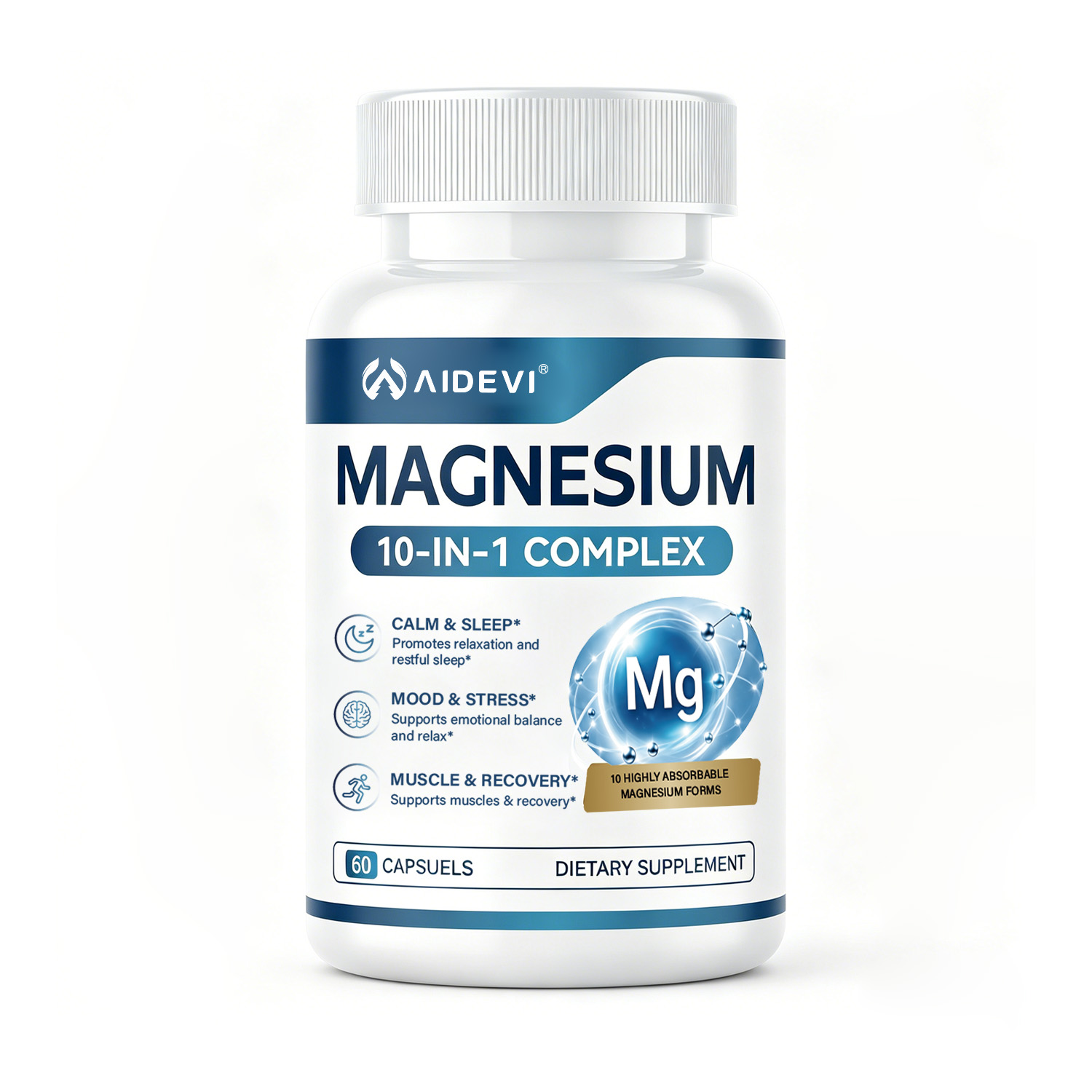
AIDEVI’s current Magnesium 10-in-1 Complex product page is a useful example because it states the elemental amount and separately lists ten magnesium-source weights. The page identifies a serving as two capsules and lists 120 mg magnesium, or 29% Daily Value, alongside the source amounts below.[6]
| Label entry per two-capsule serving | Amount | How to interpret it |
|---|---|---|
| Magnesium | 120 mg · 29% DV | Elemental magnesium stated for the serving. |
| Magnesium glycinate | 170 mg | Source-compound weight |
| Magnesium citrate | 150 mg | Source-compound weight |
| Magnesium malate | 130 mg | Source-compound weight |
| Magnesium L-threonate | 100 mg | Source-compound weight |
| Magnesium succinate | 80 mg | Source-compound weight |
| Magnesium taurate | 60 mg | Source-compound weight |
| Magnesium lactate | 60 mg | Source-compound weight |
| Magnesium carbonate | 40 mg | Source-compound weight |
| Magnesium oxide | 40 mg | Source-compound weight |
| Magnesium gluconate | 20 mg | Source-compound weight |
| Ten source weights combined | 850 mg | Not 850 mg elemental magnesium. |
The arithmetic makes the distinction concrete: the ten disclosed source weights add to 850 mg, while the product page states 120 mg elemental magnesium for the serving. The 850 mg is not another way of writing the 120 mg, and the two figures should not be added together. This example is specific to the listed product information; it is not a formula for converting other magnesium blends.
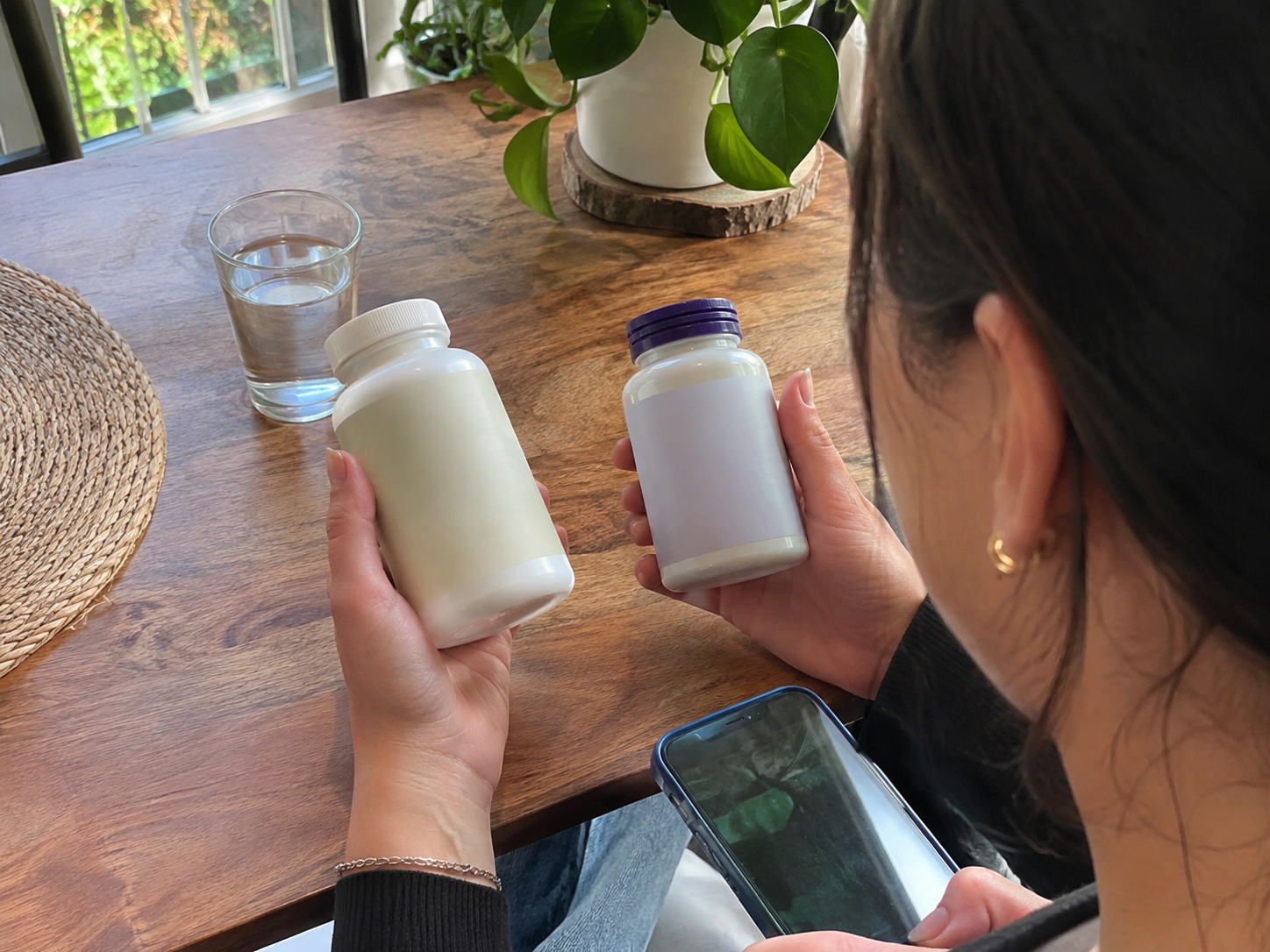
How should you compare magnesium products and %DV?
Use a short checklist before deciding that one bottle has “more magnesium”:
- Match serving sizes. Compare the same number of capsules or equivalent scoops, not one capsule against a two-capsule serving.
- Compare elemental milligrams. This is the clearest number for comparing the amount of magnesium between U.S. Supplement Facts panels.
- Then look at the form. Glycinate, citrate, oxide, and other names identify different magnesium sources. Choose based on a product’s full label and your own needs; a bigger compound-weight number does not establish a bigger elemental amount or a better formula.
- Check the %DV as a label cross-check. FDA’s Daily Value for magnesium is 420 mg for adults and children age 4 and older. A serving with 120 mg is 120 ÷ 420 = 28.6%, which rounds to 29% DV.[5]
- Review your total supplemental sources. A multivitamin, magnesium product, antacid, or laxative may add magnesium. Check with a clinician or pharmacist if you use medication or have a health condition that affects magnesium handling.
The %DV is a standardized label reference, not a personalized target or a safety ceiling. NIH ODS lists an adult tolerable upper intake level of 350 mg per day from supplements and medications; this limit does not include naturally occurring magnesium in food. It is not a recommendation to take 350 mg, and a clinician may direct different care for a medical reason.[1] More is not automatically better. People taking medicines or managing kidney problems should ask a health professional before adding a magnesium supplement.
Frequently asked questions
Does 500 mg of magnesium glycinate mean 500 mg of magnesium?
Not necessarily. If “500 mg” describes the full magnesium glycinate compound, it is not 500 mg elemental magnesium. Pure anhydrous magnesium bisglycinate would contain about 70 mg elemental magnesium in 500 mg by formula math, but a commercial product can differ. If the Supplement Facts says “Magnesium 500 mg (as magnesium glycinate),” that is a different label statement: the 500 mg magnesium amount is the elemental figure.
Is magnesium oxide 500 mg the same as 500 mg elemental magnesium?
No. Pure magnesium oxide is about 60.3% magnesium by mass, so 500 mg of pure MgO is roughly 302 mg magnesium by formula. On a supplement, use the product’s stated elemental amount rather than relying on that theoretical calculation.
Can I add the weights of several magnesium forms?
You can add separately disclosed source-compound weights to understand their combined ingredient mass, but that total is not the elemental magnesium amount. Find the Magnesium row for the elemental total. If that amount is not clear, request it from the manufacturer.
Does a higher elemental percentage mean a better supplement?
No. The percentage is a chemical mass fraction for a specific compound. It does not, by itself, tell you how well a finished product is absorbed, how you will tolerate it, or whether its serving is appropriate for you. Compare the stated elemental amount, serving instructions, ingredient form, and your circumstances rather than choosing only by the largest number.
A practical way to read the number
When a magnesium label shows several numbers, first identify which one is listed as “Magnesium” in the Supplement Facts panel and confirm the serving size. That is the elemental amount to use for comparison. Treat citrate, glycinate, oxide, and other source weights as ingredient details unless the label explicitly identifies them as the elemental nutrient amount. Use formula calculations to understand the chemistry, not to guess a finished product’s dose.
References
- NIH Office of Dietary Supplements. Magnesium: Health Professional Fact Sheet.
- U.S. Food and Drug Administration. Dietary Supplement Labeling Guide: Chapter IV, Nutrition Labeling.
- PubChem. Magnesium oxide, CID 14792.
- PubChem. Magnesium glycinate, CID 84645.
- U.S. Food and Drug Administration. Daily Value on the Nutrition and Supplement Facts Labels.
- AIDEVI. Magnesium 10-in-1 Complex product information.
These statements have not been evaluated by the Food and Drug Administration. This product is not intended to diagnose, treat, cure, or prevent any disease.
