

AIDEVI Science Guide
How Does NAD+ Become NADH? The Redox Cycle Explained
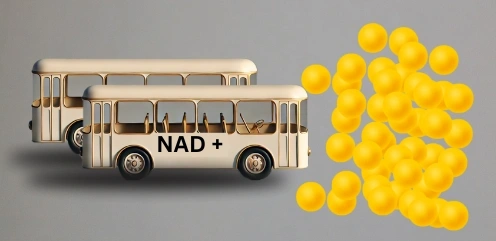
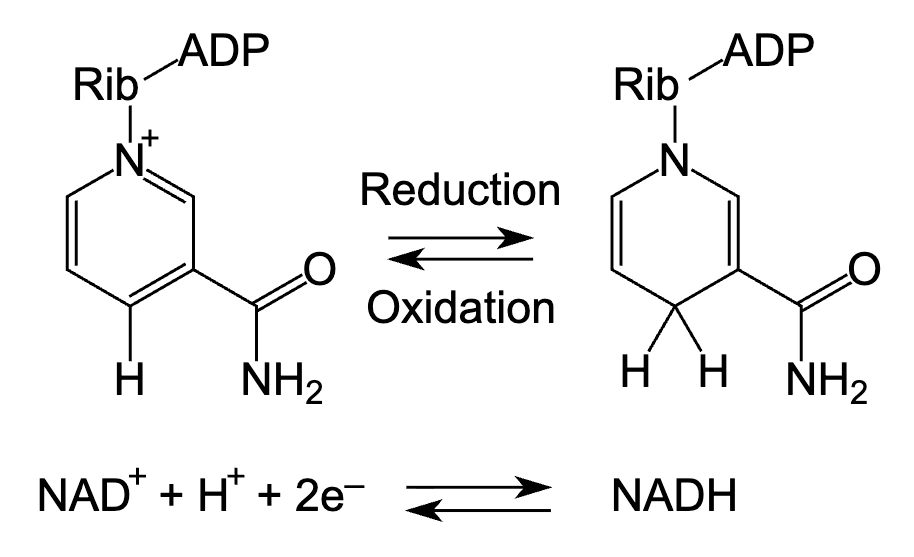
NAD+ becomes NADH when an enzyme transfers electrons from a nutrient-derived molecule to NAD+. This reduction reaction stores those electrons temporarily; NADH can then deliver them to other reactions, including the mitochondrial electron transport chain, where NAD+ is regenerated. The process is a repeating part of metabolism—not a direct measure of how energetic a person feels.

NAD+ + 2e− + H+ ⇌ NADH
In many enzyme reactions, NAD+ accepts a hydride equivalent (two electrons and a proton) from another molecule. The exact reaction depends on the enzyme and substrate; the equation is a simplified way to show the reversible redox pair.
What do NAD+ and NADH mean?
Nicotinamide adenine dinucleotide (NAD) is a coenzyme that cycles between two forms. NAD+ is the oxidized form: it can accept electrons in a reaction. NADH is the reduced form: it carries the accepted electrons and can donate them in another reaction. “Oxidized” and “reduced” describe electron transfer; they do not mean that one form is healthy and the other is harmful.
The plus sign in NAD+ identifies its oxidized chemical form; it is not a score of energy or a sign that NAD+ is more beneficial than NADH. A cell needs both forms. NAD+ accepts electrons in reactions that break down fuel, while NADH later gives electrons to other reactions. If a pathway could not regenerate NAD+, some steps that depend on it would slow.
NAD+ also has roles beyond this reversible redox cycle. Enzymes such as sirtuins, PARPs, and CD38 use or consume NAD+ in cell signaling and other processes. Those reactions are chemically different from NAD+ accepting electrons and becoming NADH, even though both contribute to the cell’s NAD+ balance.[7]
| Feature | NAD+ | NADH |
|---|---|---|
| Redox state | Oxidized; ready to accept electrons. | Reduced; carrying electrons that can be transferred. |
| Common role | Accepts electrons in reactions that break down nutrients and in other enzyme processes. | Delivers electrons to reactions such as the mitochondrial electron transport chain. |
| Relationship | Becomes NADH when reduced. | Becomes NAD+ again when oxidized. |
Where does NAD+ become NADH?
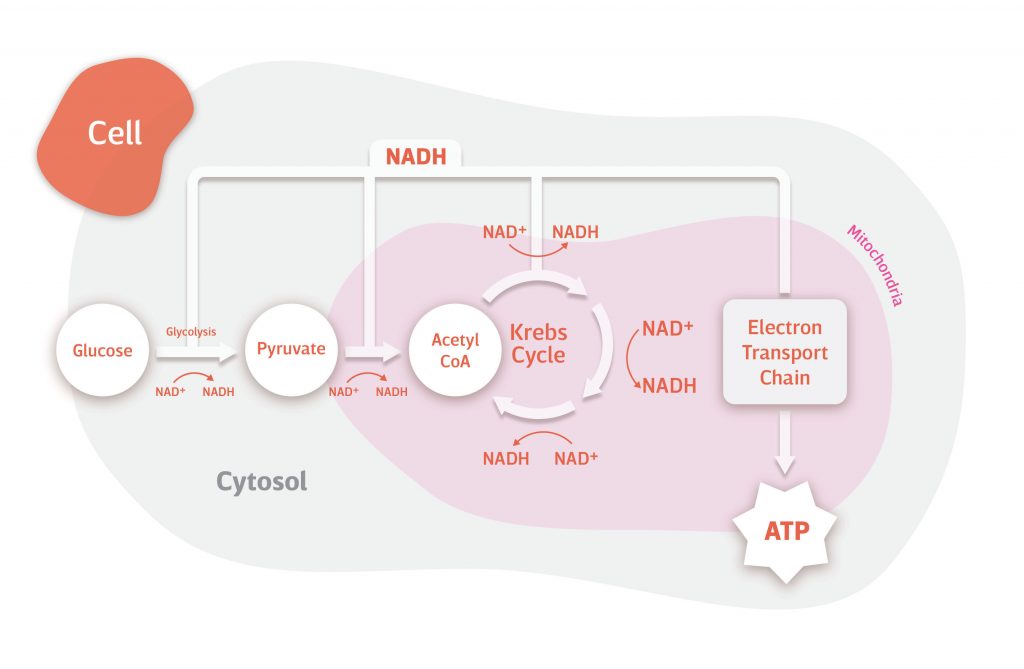
The conversion happens in many enzyme-catalyzed reactions. Two familiar examples are glycolysis in the cell cytosol and the citric acid (TCA) cycle in mitochondria. In each case, a metabolic substrate loses electrons while NAD+ accepts them. NADH then carries those reducing equivalents to another reaction. The cell does not make NADH in only one location or from only one type of food; carbohydrate, fat, and amino-acid metabolism can all feed into pathways that reduce NAD+.
During glycolysis
As glucose is broken down in the cytosol, the enzyme glyceraldehyde-3-phosphate dehydrogenase transfers electrons to NAD+, forming NADH. Because one glucose molecule is split into two three-carbon molecules before this step, glycolysis produces two NADH molecules per glucose. Glycolysis also needs a supply of NAD+ to keep this step running.
One route for regenerating cytosolic NAD+ is the lactate dehydrogenase reaction: it transfers electrons from NADH to pyruvate, forming lactate. Lactate can be produced when glycolytic flux is high even when oxygen is present, so its production is not a simple on/off sign of oxygen deprivation.[5] In other conditions, cytosolic reducing equivalents can be passed toward mitochondria through shuttle systems, which also helps restore NAD+ for glycolysis.
During the citric acid cycle
Before the TCA cycle, pyruvate from glycolysis is converted to acetyl-CoA in the mitochondrion, producing NADH as carbon enters aerobic metabolism. In the mitochondrial matrix, several TCA-cycle reactions then transfer electrons from fuel-derived intermediates to NAD+. One turn of the cycle per acetyl-CoA produces three NADH; because one glucose can yield two acetyl-CoA, the cycle produces six NADH per glucose.
Fat breakdown also contributes: each round of mitochondrial fatty-acid beta-oxidation produces NADH as well as a second electron carrier, FADH2. Amino-acid breakdown can feed into the TCA cycle or related pathways too. The precise amount of NADH formed depends on the fuel and the route by which the cell processes it.
NADH is not ATP. It is an electron carrier that can feed electrons into oxidative phosphorylation. That distinction matters: the cell must transfer the electrons through additional reactions before the proton gradient can drive ATP synthase.

How does NADH turn back into NAD+?
During aerobic respiration, mitochondrial NADH donates a pair of electrons to Complex I of the electron transport chain. The electrons pass through protein-bound carriers to ubiquinone, then move through later complexes and ultimately help reduce oxygen to water. Complex I uses part of the energy released during electron transfer to pump protons across the inner mitochondrial membrane. ATP synthase uses the resulting proton gradient to produce ATP, while Complex I converts NADH back to NAD+ so it can be used again.[6]
The amount of ATP associated with an NADH molecule is not a fixed number in every setting. It depends on the pathway, the cell, and how reducing equivalents reach the mitochondrion. For example, electrons from cytosolic NADH can enter through different shuttles; the glycerol-3-phosphate shuttle passes them to a different point in the respiratory chain than the malate-aspartate shuttle. The older shorthand that each NADH always produces a set number of ATP molecules therefore oversimplifies cellular energy accounting.
NADH made in the cytosol does not simply pass through the inner mitochondrial membrane. Cells use shuttle systems, including the malate-aspartate and glycerol-3-phosphate shuttles, to transfer its electrons into mitochondrial metabolism. This is one reason cytosolic and mitochondrial redox states can differ.[2][4]
Is there one ideal NAD+/NADH balance?
No single ratio describes the entire body. NAD+ and NADH levels vary by tissue, cell type, subcellular compartment, and metabolic state. Research tools that measure cytosolic and mitochondrial NAD+/NADH separately show why a measurement in one compartment should not be treated as a complete picture of another.[2]
The ratio also changes with the reactions happening in that compartment. When a pathway is actively transferring electrons to NAD+, more NADH may be formed locally; when NADH is being oxidized or shuttle activity changes, the balance can shift the other way. Meanwhile, NAD+ synthesis and NAD+-consuming enzymes affect the size of the available pool. A ratio is therefore a snapshot of a specific sample and method, not a universal target that applies to every organ or person.
A blood NAD+ result is also not the same as a direct measurement of the NAD+/NADH state inside a person’s mitochondria. The result depends on what was measured and how the sample was collected and processed. The ratio is a useful concept in biochemistry and research, but this article does not provide a target number for self-diagnosis.
NADH is not the same as NADPH
NADH and NADPH are related coenzymes, but they are not interchangeable. NADH is commonly discussed in energy metabolism and electron transfer to oxidative phosphorylation. NADPH is commonly used for reductive biosynthesis and for maintaining antioxidant systems such as glutathione. Both participate in cellular redox chemistry, but saying that NADH itself “neutralizes free radicals” confuses distinct pathways and cofactors.[1]

Do nmn or NR supplements directly convert NAD+ into NADH?
No. NMN and NR are precursors involved in NAD+ biosynthesis; NAD+ and NADH interconvert through enzyme-catalyzed redox reactions. These are connected parts of metabolism, but they are not the same process. Raising a measured NAD-related marker does not, by itself, prove that a supplement has improved mitochondrial ATP production or changed how energetic someone feels.
A 2026 randomized, open-label study in 65 healthy adults found that 14 days of NMN and NR supplementation increased circulating NAD+ to a similar extent. The study measured blood and microbial metabolism; it was not a test of the NAD+/NADH ratio in every tissue, a longevity trial, or proof of a noticeable energy benefit.[3]
For the separate question of how NMN and NAD+ supplements compare, see the AIDEVI NAD+ vs NMN comparison. This article focuses on the biochemical NAD+/NADH cycle rather than recommending a supplement or dose.
Frequently asked questions
Does NAD+ become NADH in one step?
It can happen in a single enzyme-catalyzed redox reaction when NAD+ accepts electrons from a substrate. Across the whole cell, many enzymes and pathways generate or use NADH, so the overall cycle is a network of reactions rather than one universal step.
Is NADH the same thing as ATP?
No. NADH carries electrons. In oxidative phosphorylation, electron transfer helps create the proton gradient that ATP synthase uses to make ATP. NADH contributes to this process but is not itself the cell’s usable ATP molecule.
Does NADH only come from carbohydrates?
No. Carbohydrate breakdown is one source, but fatty-acid oxidation and amino-acid metabolism also produce NADH through enzyme reactions. The route and amount depend on the fuel being used and the cell’s metabolic state.
Can NADH made in the cytosol enter mitochondria directly?
No. The inner mitochondrial membrane does not freely transport NADH. Shuttle systems transfer its reducing equivalents across the membrane indirectly, while the NADH molecule itself remains in its compartment.
Does the NAD+/NADH ratio show how energetic I am?
Not on its own. The ratio is compartment- and tissue-dependent, and a laboratory measurement does not directly predict subjective energy. Persistent fatigue can have many causes and should not be self-diagnosed from supplement marketing or a single NAD-related result.
References
- Lewis CA et al. Tracing compartmentalized NADPH metabolism in the cytosol and mitochondria of mammalian cells. Molecular Cell, 2014.
- Hung YP et al. Genetically encoded biosensors for evaluating NAD+/NADH ratio in cytosolic and mitochondrial compartments. Cell Reports Methods, 2021.
- Christen S et al. The differential impact of three different NAD+ boosters on circulatory NAD and microbial metabolism in humans. Nature Metabolism, 2026.
- Xiao W et al. NAD(H) and NADP(H) redox couples and cellular energy metabolism. Antioxidants & Redox Signaling, 2018.
- Brooks GA. The tortuous path of lactate shuttle discovery: from cinders and boards to the lab and ICU. Journal of Sport and Health Science, 2020.
- Jones AJY et al. Respiratory Complex I in Bos taurus and Paracoccus denitrificans pumps four protons across the membrane for every NADH oxidized. Journal of Biological Chemistry, 2017.
- Zapata-Pérez R et al. NAD+ homeostasis in human health and disease. EMBO Molecular Medicine, 2021.
These statements have not been evaluated by the Food and Drug Administration. This product is not intended to diagnose, treat, cure, or prevent any disease. This article is for educational purposes only. Individual results may vary. Consult a healthcare professional with questions about your health or before using any dietary supplement.
