








AIDEVI Wellness Guide
Black Ginger: Human Evidence, Safety & Daily Use
Black ginger usually refers to Kaempferia parviflora, a Southeast Asian rhizome that is different from the common culinary ginger Zingiber officinale. A small number of human studies have examined specific black ginger extracts for body composition, fitness, or sexual-function measures. Those results are early and extract-specific: they do not establish a universal daily dose, a testosterone effect, or a proven treatment for erectile dysfunction.
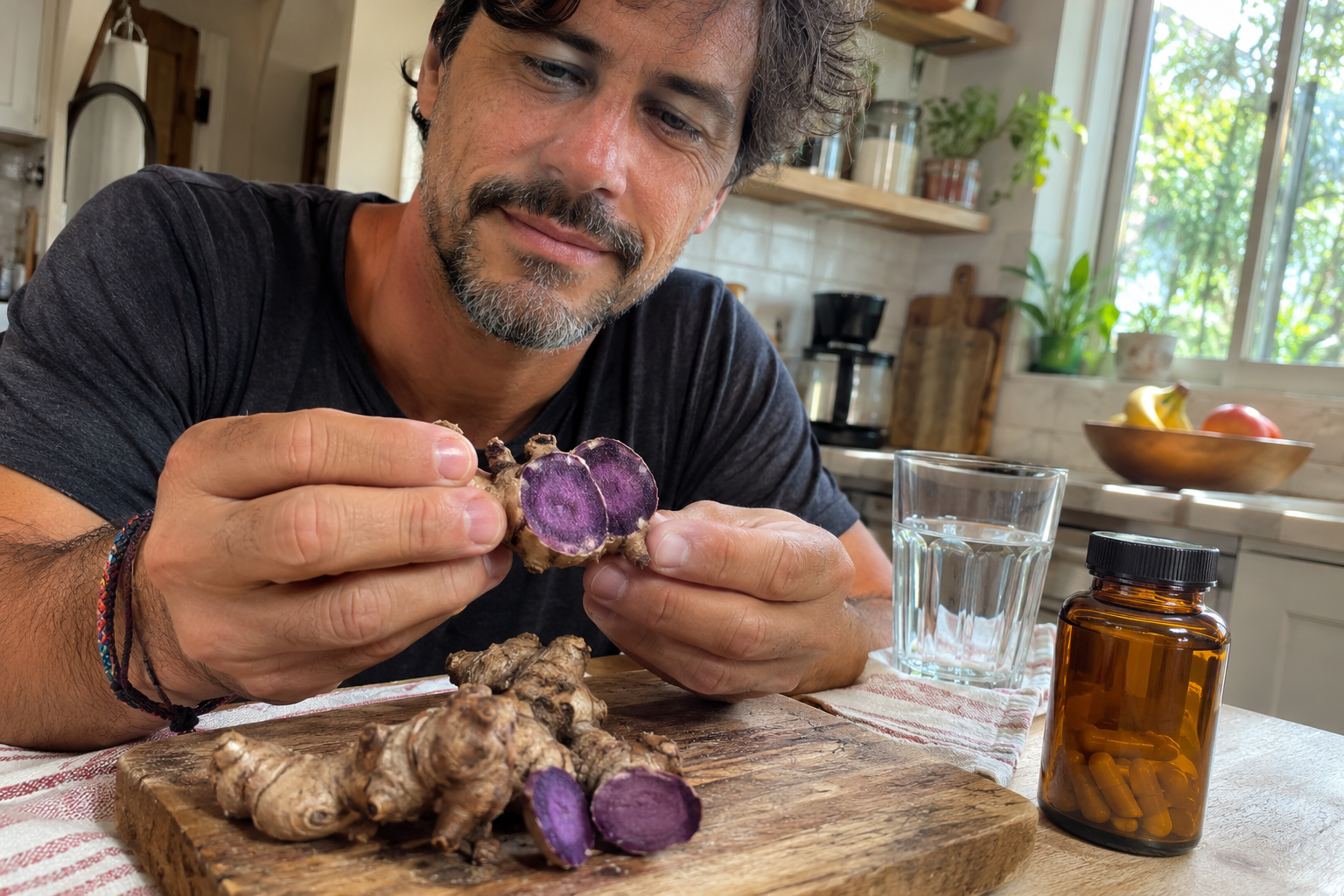
Illustrative lifestyle photography. The unbranded bottle is not a tested product or endorsement.
- The most useful evidence comes from small trials of named extracts, not from black ginger as a single interchangeable ingredient.
- One small, uncontrolled pilot explored erectile-function questionnaires in men; it cannot prove that black ginger treats erectile dysfunction or raises testosterone.
- Short trials do not define long-term safety or one best dose and timing for everyday use.
What is black ginger, and is it the same as regular ginger?
Kaempferia parviflora is commonly called black ginger, Thai black ginger, or krachai dam. It belongs to the ginger family, but it is a different species from the culinary ginger used in tea and cooking. Its rhizome can have a deep purple interior. A product that says only “ginger” may therefore refer to another plant; check the botanical name rather than relying on the common name.
This distinction also matters when reviewing studies. Human trials have used particular extracts made from K. parviflora, with their own extraction processes and marker profiles. Evidence on one preparation does not automatically apply to ordinary ginger, a differently processed black ginger extract, or a multi-ingredient liquid.
What does human research on black ginger show?
Research is still limited. Several trials have reported findings in body-composition or fitness measures, but they studied different extracts and populations. The table summarizes the study design and outcome together so a result is not mistaken for a general promise.
| Human study | What was tested | What the result can—and cannot—say |
|---|---|---|
| Body composition, Japan (2018) | A 12-week randomized, double-blind, placebo-controlled trial randomized 76 adults with overweight or pre-obesity to 150 mg/day of a K. parviflora extract or placebo; 74 were included in efficacy analyses. | The extract group had greater reductions in abdominal fat-area measures than placebo. This was a small, single-center study; it does not establish treatment of obesity or metabolic disease. [1] |
| Body composition, Korea (2025) | A 12-week placebo-controlled trial analyzed 83 adults with overweight who received a daily capsule containing 50 mg of K. parviflora ethanol extract within a 100 mg SIRTMAX® ingredient preparation. | Adjusted body-fat mass change favored the extract, while the between-group difference in body-fat percentage was not statistically significant. Several authors were employed by companies connected to the tested extract. [2] |
| Fitness measures, Thailand (2012) | Forty-five healthy adults over age 60 were assigned to placebo or 25 mg/day or 90 mg/day of a standardized extract for eight weeks. | The 90 mg group improved on some chair-stand and six-minute-walk measures. The small, specific sample means the result needs replication before it can be generalized to younger adults or athletic performance. [3] |
| Sexual-function pilot, United States (2018) | An open-label, one-arm pilot gave 100 mg/day of KaempMax™ extract for 30 days to 14 generally healthy men aged 50–68 with self-reported mild erectile dysfunction. | Participants reported changes on sexual-function questionnaires, but there was no placebo group. This cannot establish a treatment effect, a testosterone effect, or a guaranteed benefit for men. [4] |
Taken together, these studies are a reason for further research—not a reason to treat all black ginger supplements as equivalent. The 2018 and 2025 body-composition trials used different extracts and doses. The newer trial also found a body-fat-mass result that did not translate into a statistically significant between-group change in body-fat percentage. Study outcomes should be read at that level of detail, rather than summarized as “black ginger causes weight loss.”
What are the claimed black ginger benefits for men?
Searches for “male black ginger” and “black ginger benefits for men” often point to energy, exercise, or sexual-function claims. Human evidence does not support treating those claims as established outcomes. The small sexual-function pilot was uncontrolled, involved only 14 men, and measured questionnaire responses over one month. It did not establish black ginger as a treatment for erectile dysfunction or demonstrate that it raises testosterone.
If you are experiencing persistent erectile difficulties, low energy, or a sudden change in exercise tolerance, a clinician can check for causes that need specific care. A supplement should not delay that evaluation or replace prescribed treatment. Future controlled trials would need to test a defined extract against placebo, use clinically relevant outcomes, and include enough participants to determine whether any effect is reliable.
Can you take black ginger daily, and what dose is established?
There is no universally established daily dose for black ginger. Published studies have used different extracts and amounts: 25 or 90 mg/day in one fitness study, 150 mg/day of a different extract in a body-composition trial, and 50 mg/day of the K. parviflora extract within the 2025 SIRTMAX® preparation. Those numbers describe research protocols. They are not interchangeable dose recommendations.
One 2019 safety trial enrolled 52 healthy Japanese adults and tested five tablets per day, each containing 150 mg of the branded KPFORCE™ preparation, for four weeks. The investigators reported no adverse events related to intake and no notable differences in measured health parameters versus placebo. That short study of healthy adults cannot settle long-term safety, safety in people with chronic conditions, or the safety of other black ginger products. [5]
Study timing also varies. The 2025 trial used its capsule before breakfast, but a study protocol does not establish that morning is the best time, that an empty stomach is necessary, or that another formulation should be taken the same way. Follow the directions on the product you have and ask a pharmacist or health professional if you take medication, have a medical condition, are pregnant or breastfeeding, or are planning surgery. Human interaction and long-term safety data remain limited.
How do you compare black ginger supplement labels?
Look for Kaempferia parviflora by name and check the amount per serving, the serving size, the extract form, and any standardization information. A label should help you distinguish black ginger from common ginger and tell you whether the product contains a standalone extract or a blend. FDA requires dietary supplement labels to identify serving size, dietary ingredients, and amounts per serving; FDA does not pre-approve supplements for safety and effectiveness before sale. [6]
- Botanical identity: Is Kaempferia parviflora named, and is the plant part stated?
- Amount per serving: Does the number refer to the black ginger extract itself, a broader extract preparation, or the whole blend?
- Extract description: Is the extraction method or marker standardization disclosed well enough to compare it with the study being cited?
- Other active ingredients: Does the formula include additional botanicals or stimulants that change the safety question?
If a manufacturer offers a quality certificate or third-party test, check what it actually covers, such as ingredient identity or contaminant screening. Those checks may help with product quality, but they do not show that the finished supplement improves body composition, sexual function, or another health outcome. If the public product information leaves out the amount of a blend ingredient, do not infer it from a study on a standalone extract.
AIDEVI’s current Blitz-Meta product page names Black Ginger (Kaempferia parviflora) as one ingredient in a multi-ingredient liquid. The accessible page does not disclose a standalone black ginger amount. That means you cannot compare the product’s black ginger exposure with a single-ingredient study from the public information alone, and trial doses should not be mapped onto the blend. Review the current physical Supplement Facts label for details. [7]
Frequently asked questions
Is black ginger the same as common ginger?
No. Black ginger usually means Kaempferia parviflora; common culinary ginger is Zingiber officinale. They are related plants but not interchangeable supplement ingredients.
Does black ginger increase testosterone?
The human studies summarized here do not establish a testosterone-boosting effect. The men's pilot measured erectile-function questionnaire responses, not proof of a hormone effect.
What is the best time to take black ginger?
No best time has been established. One research capsule was taken before breakfast, but that protocol does not show that morning timing is superior. Follow the current product label.
Are black ginger side effects known?
Short studies have not identified a consistent serious safety signal, but the sample sizes and durations are too limited to define long-term risks or interactions. Ask a health professional before use if you have a medical condition or take medication, and stop and seek advice if you experience an unexpected reaction.
References
- [1] Yoshino S, et al. Daily intake of Kaempferia parviflora extract decreases abdominal fat in overweight and preobese subjects: a randomized, double-blind, placebo-controlled clinical study. Diabetes Metab Syndr Obes. 2018.
- [2] Sung HK, et al. Kaempferia parviflora Extract (SIRTMAX®) reduces body fat in adults who are overweight: a 12-week randomized, double-blind, placebo-controlled trial. Front Nutr. 2025.
- [3] Wattanathorn J, et al. Positive Modulation Effect of 8-Week Consumption of Kaempferia parviflora on Health-Related Physical Fitness and Oxidative Status in Healthy Elderly Volunteers. Evid Based Complement Alternat Med. 2012.
- [4] Stein RA, et al. Kaempferia parviflora ethanol extract improves self-assessed sexual health in men: a pilot study. J Integr Med. 2018.
- [5] Yoshino S, et al. Evaluation of the Safety of Daily Consumption of Kaempferia parviflora Extract (KPFORCE): A Randomized Double-Blind Placebo-Controlled Trial. J Med Food. 2019.
- [6] U.S. Food and Drug Administration. FDA 101: Dietary Supplements.
- [7] AIDEVI. Blitz-Meta product information, accessed November 2026.
These statements have not been evaluated by the Food and Drug Administration. This product is not intended to diagnose, treat, cure, or prevent any disease.
