










AIDEVI Wellness Guide
Does Magnesium Help with Sleep? Forms, Evidence & Labels
Magnesium may modestly improve some sleep measures for some adults, but research is mixed and does not support treating it as a reliable insomnia remedy. A 2025 trial of magnesium bisglycinate found a small improvement on one self-reported insomnia scale; other trials and outcomes have been less consistent. No magnesium form has been proven best for sleep.

Illustrative lifestyle photography. The bottle is unbranded and the scene does not suggest a sleep result.
- A few small trials report possible improvements, but the overall evidence remains inconsistent and low certainty.
- No clinical trial has directly shown that glycinate is better than citrate, oxide, or another form for sleep.
- Use the “Magnesium” amount on Supplement Facts to compare elemental magnesium. Do not add the weights of magnesium salts and call the total elemental magnesium.
- The adult upper limit of 350 mg applies to magnesium from supplements and medicines, not magnesium naturally present in food. It is a safety limit, not a sleep dose.
In this guide
Does magnesium help with sleep?
The honest answer is “possibly, but it is not established as a routine sleep aid.” Magnesium is an essential mineral involved in normal nerve and muscle function. That role gives researchers a reason to study magnesium and sleep, but it does not mean that extra magnesium will make a person fall asleep faster or sleep more deeply if their intake is already adequate.
A 2025 VA/DoD clinical practice guideline found insufficient evidence to recommend for or against magnesium for chronic insomnia. A larger systematic review published in 2026 likewise found mixed results across self-reported sleep, EEG, actigraphy, wearable estimates, and other measures; it rated certainty low to very low and concluded that oral magnesium is not supported as a routine insomnia treatment.[1][2]

What do human studies show?
The studies differ in age, sleep symptoms, magnesium form, amount, duration, and how sleep was measured. A subjective questionnaire, an activity ring, and a sleep-lab measurement are not interchangeable. These findings are best read as early signals rather than proof that a magnesium supplement will improve sleep for everyone.
| Study | Who and what was tested | Main result | Important limit |
|---|---|---|---|
| Older-adult trials, reviewed 2021 and 2025[3][1] | Three small RCTs involving about 151 older adults; magnesium oxide or citrate over 20 days to 8 weeks. | A pooled estimate from two trials found sleep-onset latency about 17 minutes shorter. Total sleep time was not significantly longer. | The pooled evidence came from only 55 people and was rated low to very low certainty; adverse effects were not systematically collected. |
| Magnesium L-threonate trial, 2024[4] | 80 adults ages 35–55 with self-reported sleep problems; 1 g/day of magnesium L-threonate compound for 21 days. | Some wearable-derived and selected questionnaire measures favored the supplement. The group-by-time difference on the Insomnia Severity Index was not significant. | Short trial, nonclinical sleep complaints, consumer wearable outcomes, and funding from the ingredient company. One gram was the compound amount, not 1 g of elemental magnesium. |
| Magnesium bisglycinate trial, 2025[5] | 155 adults ages 18–65 reporting poor sleep; 250 mg elemental magnesium daily for 4 weeks. | Insomnia Severity Index scores fell slightly more than with placebo; the between-group effect was small (Cohen’s d = 0.2). Other psychological outcomes did not differ significantly. | Self-reported outcomes, short follow-up, no objective sleep assessment, and only one study of this form. The low-intake subgroup finding was exploratory. |
| Updated RCT systematic review, 2026[2] | Randomized trials in adults, with varied formulations, populations, and outcome measures. | Results were inconsistent across questionnaires, lab measurements, and device estimates. Evidence certainty was low or very low. | No sleep trial directly compared magnesium forms, so the review could not rank one form as best. |
The practical takeaway is not that magnesium never helps. It is that current evidence cannot predict who will notice a difference, how large that difference will be, or whether one form is superior. Correcting a confirmed low intake is a different question from taking extra magnesium to treat chronic insomnia. The studies above do not establish that a supplement is necessary when dietary intake is adequate.

Which magnesium form is best for sleep?
No form has been proven best for sleep because trials have not directly compared forms in a sleep study. Some forms are absorbed differently or have different digestive effects, but better absorption does not automatically mean better sleep. Here is how common options fit the current evidence.
| Form | What the evidence says | What to keep in mind |
|---|---|---|
| Glycinate or bisglycinate | One 2025 trial found a small improvement on the Insomnia Severity Index with bisglycinate. | One trial does not show it beats citrate or works for everyone; no head-to-head sleep comparison exists. |
| Citrate | Included in some older sleep studies. NIH notes it is generally more bioavailable than oxide. | Can loosen stools for some people; bioavailability alone does not establish a sleep benefit. |
| Oxide | Appears in older insomnia trials; NIH reports lower absorption than citrate in small studies. | Some magnesium oxide products are used for digestive purposes and may cause diarrhea. |
| L-threonate | A small 2024 trial reported changes in selected wearable and daytime measures. | Results are preliminary; the tested gram amount refers to the magnesium compound, not elemental magnesium. |
If you are comparing magnesium citrate vs glycinate for sleep, prioritize a clear elemental amount, ingredients you tolerate, price, and directions that fit your healthcare advice. Claims such as “the best magnesium supplement for sleep” often go beyond what form-comparison research can prove.[6]
How do you read an elemental magnesium label?
On a U.S. Supplement Facts panel, the “Magnesium” line reports the elemental magnesium amount. The weights of magnesium glycinate, citrate, malate, or other source compounds describe the ingredients that supply magnesium; they are not interchangeable with the amount of elemental mineral.[6]
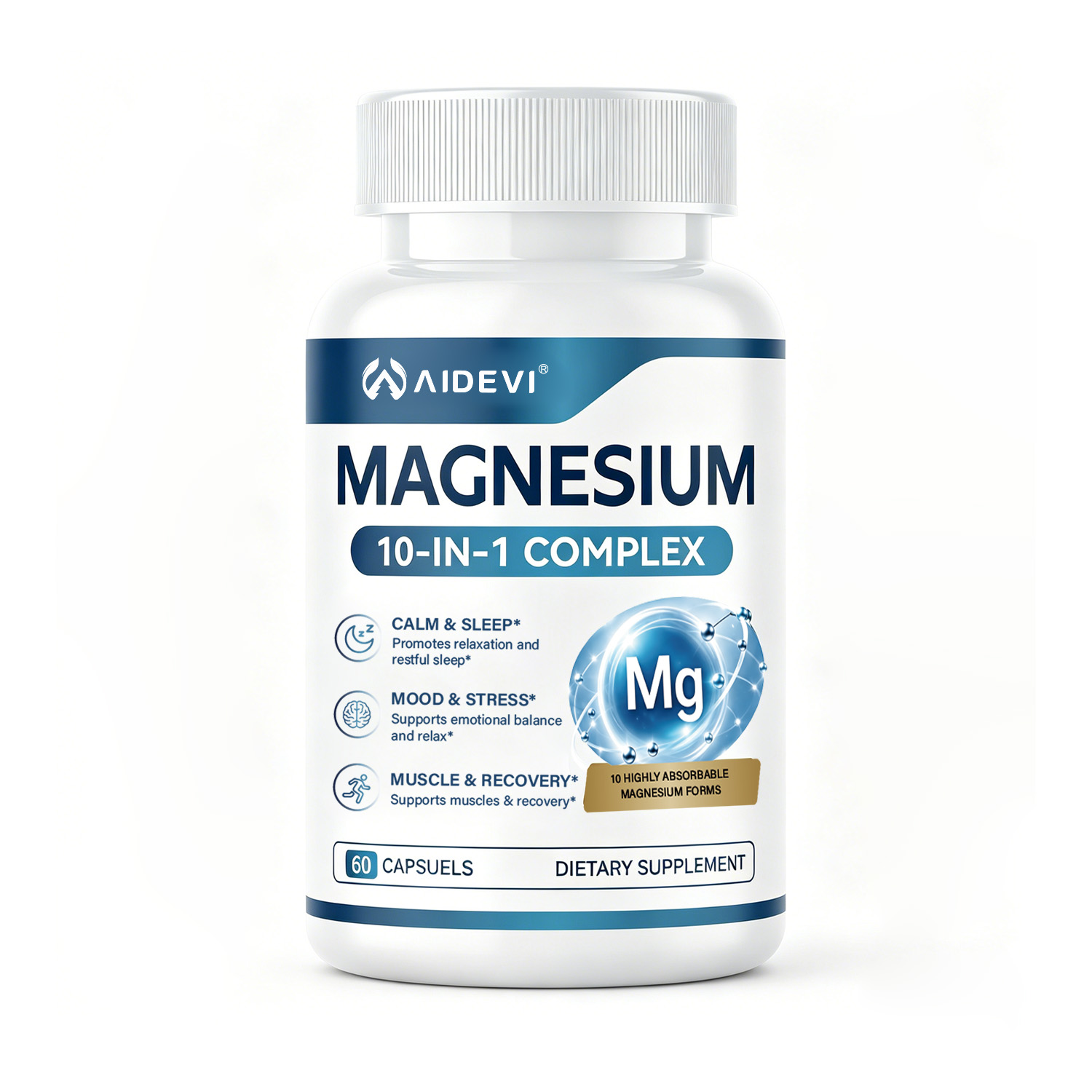
A current AIDEVI label example makes the distinction concrete. The AIDEVI Magnesium 10-in-1 product page lists a two-capsule serving with 120 mg magnesium (29% Daily Value), plus ten magnesium-source weights. Those source weights add up to 850 mg, but the product's listed elemental magnesium remains 120 mg. The compound total is not a 850 mg magnesium dose, and the label example is not evidence that the product treats insomnia.[7]
| Label information | How to read it |
|---|---|
| Serving size: 2 capsules | The listed amount applies to two capsules, not automatically to one capsule. |
| Magnesium: 120 mg | This is the elemental magnesium amount to compare across products. |
| Magnesium glycinate: 170 mg; citrate: 150 mg; other listed forms | These are source-compound weights. Do not add them together to estimate elemental magnesium. |
What about magnesium dose and safety?
For adults, the recommended daily intake varies by age and sex: roughly 310–320 mg for women and 400–420 mg for men. These recommendations refer to total intake from food, beverages, and supplements. The adult upper limit of 350 mg applies only to magnesium from supplements and medicines; it does not include magnesium naturally present in food.[6] Neither number is a recommended bedtime dose, and the upper limit is not a target to reach.
Too much supplemental magnesium can cause diarrhea, nausea, and abdominal cramping. People with impaired kidney function are at greater risk because the kidneys may not remove excess magnesium effectively. Add up magnesium from supplements and medicines such as some antacids or laxatives, and ask a healthcare professional before supplementing if you have kidney disease or have been advised to limit magnesium.[6]
Magnesium can reduce absorption of some oral antibiotics and osteoporosis medicines. For example, NIH advises spacing magnesium from tetracycline or quinolone antibiotics and oral bisphosphonates; the exact timing depends on the medication. A pharmacist can help check your specific medicines. Some diuretics and long-term proton pump inhibitor use can also affect magnesium status, so do not try to self-correct a suspected deficiency without medical guidance.[6]
If sleep problems persist, worsen, or affect daily functioning, talk with a healthcare professional about possible causes and appropriate insomnia care. Magnesium supplements are not a substitute for diagnosis or treatment, and a label that says “sleep support” does not establish a clinical benefit.
Frequently asked questions
Should you take magnesium right before bed?
There is no well-established timing rule showing that bedtime works better than another time of day. Follow the product directions and clinician advice; taking it with food may help some people who experience stomach discomfort, but it does not guarantee improved sleep.
Does magnesium glycinate work better than citrate for sleep?
That has not been shown in a head-to-head sleep trial. Glycinate has one recent placebo-controlled study with a small improvement on a self-reported insomnia scale; citrate appears in older studies. Differences between those separate studies cannot prove one form is superior.
Can magnesium cure insomnia?
No. Current evidence does not establish magnesium as a cure or routine treatment for chronic insomnia. A supplement may also delay appropriate evaluation if someone relies on it instead of seeking help for persistent sleep problems.
When evaluating a magnesium supplement for sleep, separate three questions: whether a person needs more magnesium, whether a particular form changes sleep outcomes, and whether the label states a clear elemental amount. Current research has not settled the sleep question or identified a best form, so transparent labels and realistic expectations matter.
References
- VA/DoD. Clinical Practice Guideline for the Management of Chronic Insomnia Disorder and Obstructive Sleep Apnea. 2025.
- Magnesium Supplementation for Sleep in Adults: A Systematic Review of Randomized Controlled Trials. 2026.
- Mah J, Pitre T. Oral magnesium supplementation for insomnia in older adults: a Systematic Review & Meta-Analysis. 2021.
- Hausenblas H, et al. Magnesium-L-threonate improves sleep quality and daytime functioning in adults with self-reported sleep problems: A randomized controlled trial. Sleep Medicine: X. 2024.
- Schuster J, et al. Magnesium Bisglycinate Supplementation in Healthy Adults Reporting Poor Sleep: A Randomized, Placebo-Controlled Trial. 2025.
- National Institutes of Health, Office of Dietary Supplements. Magnesium: Health Professional Fact Sheet.
- AIDEVI. Magnesium 10-in-1 Complex: current Supplement Facts and product details. Accessed November 16, 2026.
These statements have not been evaluated by the Food and Drug Administration. This product is not intended to diagnose, treat, cure, or prevent any disease. Individual results may vary. Always consult with a healthcare professional before starting any new supplement regimen.
