

AIDEVI Wellness Guide
Urolithin A Supplements: Human Evidence, Safety & Who May Benefit
Urolithin A (UA) supplements have been studied in small, short human trials, mainly for muscle function and mitochondrial or immune-cell markers. Some secondary muscle measures improved, but several primary outcomes did not. The evidence does not yet show that UA prevents aging-related disease, causes weight loss, or extends human lifespan. Who may benefit remains an open research question.
Illustrative lifestyle photography. The bottle shown is not a real product and the scene does not represent a clinical result.
- Human studies have tested daily doses from 500 to 1,000 mg for four weeks to four months, but that range is a description of research—not a personal dose recommendation.
- Findings are mixed: a few muscle endurance or strength measures improved, while some primary walking, ATP-production, power, or vascular outcomes did not.
- Short trials have not identified a clear liver-enzyme signal, but they cannot establish long-term safety or answer every interaction question.
- A useful supplement label states the exact UA amount per serving. Do not assume a product matches a clinical-trial dose when its ingredient amount is not disclosed.
In this guide
What is urolithin A?
Urolithin A is a compound that gut microbes can produce after processing ellagitannins and ellagic acid found in foods such as pomegranate, some berries, and walnuts. The amount a person produces can vary with their gut microbiome and the foods they eat. Eating a precursor food does not guarantee that you will produce a particular amount of UA; a supplement supplies UA directly rather than relying on that conversion process.[1][2]
Researchers study UA partly because of its proposed role in mitophagy, the process cells use to identify and recycle mitochondria. That biological rationale helps explain why muscle and mitochondrial markers appear in trials. A plausible mechanism, however, is not the same as proof that taking a supplement improves how a person feels, functions, or ages.

What have human trials found?
The most informative studies are randomized trials comparing UA with placebo. They are still relatively small and brief, and they measure different outcomes, so their results should not be combined into a promise of broad “healthy aging.” The table separates each study's population, tested amount, main findings, and limits.
| Human study | Population and tested intake | What changed | Key limitation |
|---|---|---|---|
| First-in-human safety study, 2019[3] | Healthy, sedentary older adults; single doses and repeated daily doses were studied, including 500 and 1,000 mg for four weeks. | The primary focus was safety and how UA appeared in blood. Some mitochondrial-related biomarkers changed at the two repeated doses. | A short safety and biomarker study cannot establish lasting improvements in strength, healthspan, or disease risk. |
| Older-adult randomized trial, 2022[4] | 66 adults ages 65–90; 1,000 mg daily for four months. | Hand and leg muscle-endurance tests improved at month two. The primary six-minute walk and muscle ATP-production outcomes were not significantly better than placebo. | Small study; participants were all White and mostly women. The endurance difference was not significant at the four-month endpoint. |
| Middle-aged ATLAS trial, 2022[5] | 88 overweight, mostly sedentary adults; 500 mg, 1,000 mg, or placebo daily for four months. | Some secondary hamstring strength measures improved in the UA groups. The primary peak-power outcome did not significantly improve; body-fat and lean-mass measures were unchanged. | One four-month trial with several measured outcomes; findings need independent replication. |
| Immune-cell proof-of-concept trial, 2025[6] | 50 healthy middle-aged adults; 1,000 mg daily for four weeks. | Selected CD8 immune-cell populations and lab measures of fatty-acid use changed. | Cell and blood markers are not evidence of fewer infections, stronger vaccine protection, or better day-to-day health. |
| Vascular and brain-response trial, 2026[7] | 50 adults ages 40–64 with obesity; 1,000 mg daily for four weeks. | The primary flow-mediated dilation outcome and other peripheral vascular measures did not improve. A brain blood-flow response during a task changed, but task performance did not. | Single-site proof-of-concept study with short follow-up; a change in a lab response is not a demonstrated cognitive benefit. |
Taken together, the trials suggest that oral UA can raise circulating UA and may affect some muscle or cellular measures in selected adults. They do not show a consistent improvement across the primary outcomes researchers chose to test. Several key studies also include authors affiliated with the ingredient developer, making independent replication especially useful when judging commercial claims.[3][4][5][6]
Who may benefit from a urolithin A supplement?
There is not yet a proven “responder profile.” The most direct human evidence concerns healthy or overweight middle-aged adults and adults over 65 who took a studied UA preparation for weeks or a few months. If you are an older adult interested in muscle endurance, or a midlife adult reading about mitochondrial health, those populations are closer to the research than children, pregnant people, or people with complex medical conditions. That similarity does not mean you will get the same result.
For an individual, potential relevance depends on the goal. Someone seeking a treatment for fatigue, a diagnosed condition, rapid weight loss, or a guaranteed anti-aging effect should not use UA as a substitute for medical evaluation or established care. Current human trials do not establish UA as a weight-loss aid, a way to prevent chronic disease, or a proven lifespan extender. In the middle-aged trial, body-composition measures did not change, and the 2026 vascular study did not improve its primary outcome.
Regular movement, progressive strength exercise, adequate nutrition, sleep, and care for existing health conditions have practical roles that UA studies do not replace. A supplement decision makes more sense as a personal discussion about evidence, cost, product transparency, and health context than as a shortcut around those foundations.
What is known about urolithin A safety?
Short-term trials in selected adults have generally described UA as tolerable. In the 2025 four-week study, researchers reported no significant change in liver enzymes or kidney-function measures, and the number of adverse events was similar in the UA and placebo groups.[6] This is reassuring for those specific participants and timeframe, but it does not prove that every product is safe for every person or that years of daily use carry no risk.
The evidence base is too small to answer every question about uncommon reactions, long-term use, pregnancy or breastfeeding, use by people under 18, or interactions with medicines. Ask a healthcare professional or pharmacist before starting UA if you take prescription medicines, have liver or kidney disease, are pregnant or nursing, or are managing a chronic condition. Bring the exact product label so they can review the full formula, not just the UA ingredient.
A “no significant change” in short-term liver tests is not a claim that liver risks are impossible; it means the study did not detect a change in that small group over that short period. Report a suspected adverse effect to a healthcare professional and stop taking a supplement if you develop a concerning reaction.
How should you compare urolithin A supplement labels?
When comparing the best urolithin A supplement for your needs, first check what the label lets you verify. The U.S. Supplement Facts panel is where to check serving size and ingredient information; for a formula blend, see whether the amount of UA is stated separately.[9] A supplement is not automatically comparable to the study material just because “urolithin A” appears on its product page. The trial amounts are evidence about specific research preparations, not a universal target for shoppers.

- Amount per serving: Look for a clearly stated UA quantity in milligrams and confirm how many capsules, softgels, or milliliters make one serving. If the formula uses a blend, check whether the UA amount is itemized.
- Full ingredient list: Review active ingredients, other ingredients, allergens, serving size, and directions. A product with several actives cannot be assumed to have the same effects or safety profile as a UA-only study product.
- Quality details: Look for a complete manufacturer contact, lot and expiration information, and accessible quality documentation. If a company mentions third-party testing, ask what was tested and whether the results identify the finished product and lot.
- Realistic claims: Be cautious of promises to reverse aging, melt fat, prevent disease, or produce guaranteed energy. Those claims go beyond the human outcomes summarized here.
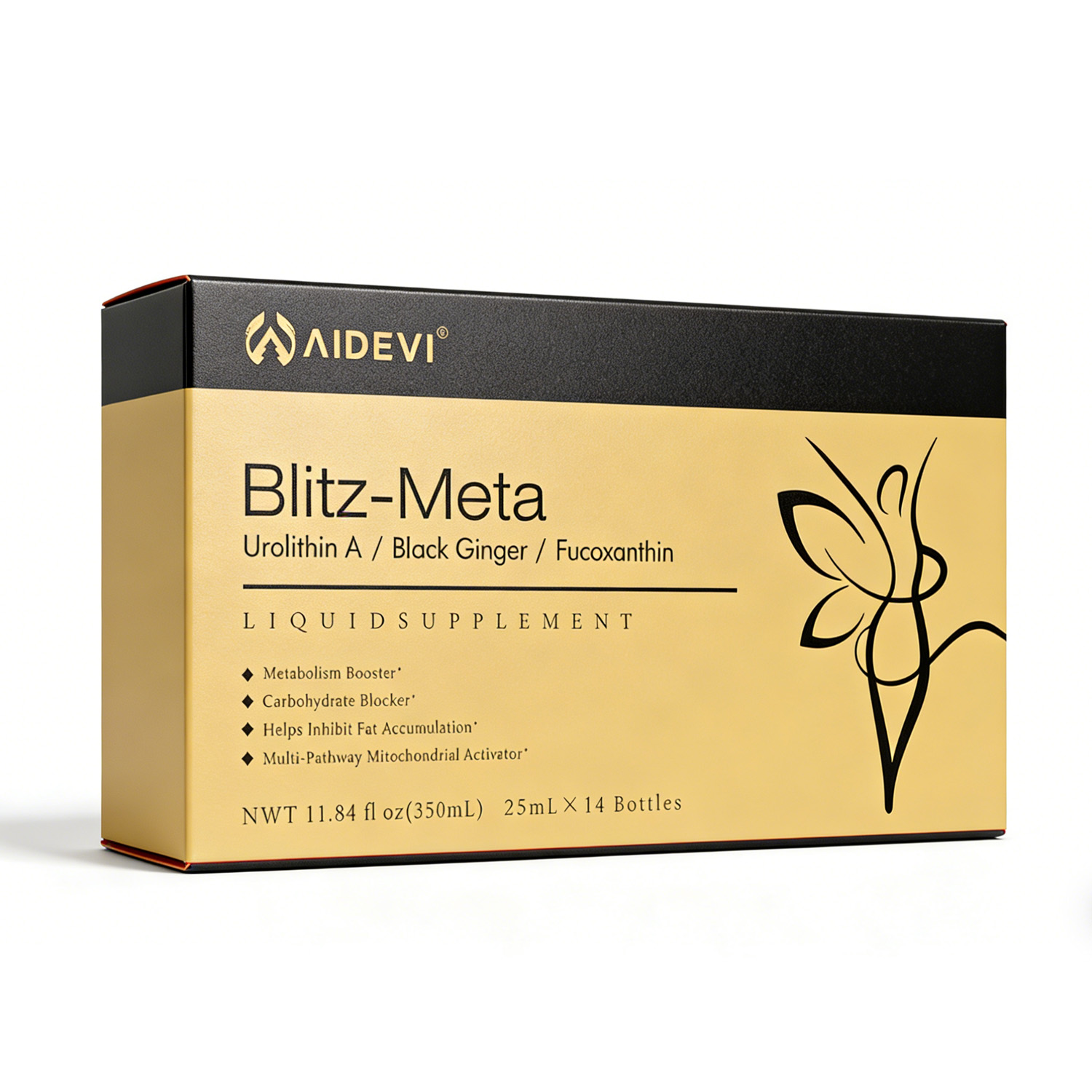
For transparency, AIDEVI's Blitz-Meta product page lists Urolithin A among several formula ingredients and gives a suggested one-bottle daily use, but the page does not state a standalone milligram amount for UA. That means a reader cannot use the public page to compare its UA amount with the 500 mg or 1,000 mg doses used in several trials. The ingredient's presence alone should not be read as evidence that the product matches a study dose or outcome.[8]
Frequently asked questions
Does eating pomegranate give you the same amount as a urolithin A supplement?
No. Pomegranate and other ellagitannin-containing foods provide precursors that gut microbes may convert into urolithins. Production varies between people, and a food serving is not equivalent to a measured amount of UA in a supplement.[1][2]
What is the proven dose of urolithin A?
There is no universally established dose for consumers. Trials have tested different amounts, commonly 500 mg or 1,000 mg per day for up to four months. Those study designs do not establish that either amount is appropriate for you, or that another product with a different formulation will have the same effect.
Can urolithin A help with weight loss or anti-aging?
Human evidence does not establish UA as a weight-loss treatment or prove that it slows aging or extends lifespan. Some studies measured muscle or cellular markers, while the middle-aged ATLAS trial found no change in body-fat or lean-mass measures after four months.[5]
Do trials show that urolithin A harms the liver?
The cited short-term studies did not identify a significant change in liver enzymes, but small studies lasting weeks or months cannot settle every long-term or rare safety question. If you have liver disease or take medication, review the product with a clinician before use.[6]
The most useful way to read current urolithin A research is to keep the population, study dose, time period, and outcome together. There are promising signals worth testing further, especially around selected muscle measures, but evidence remains preliminary for broad health outcomes. If you compare products, choose one whose amount and full formula are clear, and discuss personal safety questions with a healthcare professional.
References
- D’Amico D, et al. Direct supplementation with Urolithin A overcomes limitations of dietary exposure and gut microbiome variability in healthy adults to achieve consistent levels across the population. Nutrients. 2021.
- González-Sarrías A, et al. Correlation between intestinal microbiota and urolithin metabolism in a human walnut dietary intervention. 2024.
- Andreux PA, et al. The mitophagy activator urolithin A is safe and induces a molecular signature of improved mitochondrial and cellular health in humans. Nature Metabolism. 2019.
- Liu S, et al. Effect of Urolithin A Supplementation on Muscle Endurance and Mitochondrial Health in Older Adults: A Randomized Clinical Trial. JAMA Network Open. 2022.
- Singh A, et al. Urolithin A improves muscle strength, exercise performance, and biomarkers of mitochondrial health in a randomized trial in middle-aged adults. Cell Reports Medicine. 2022.
- Denk D, et al. Effect of the mitophagy inducer urolithin A on age-related immune decline: a randomized, placebo-controlled trial. Nature Aging. 2025.
- da Costa Pinaffi-Langley AC, et al. Urolithin A and Endothelial and Cerebrovascular Function in Middle-Aged Adults With Obesity: A Randomized Clinical Trial. JAMA Network Open. 2026.
- AIDEVI. Blitz-Meta product page. Accessed November 16, 2026.
- U.S. Food and Drug Administration. FDA 101: Dietary Supplements.
These statements have not been evaluated by the Food and Drug Administration. This product is not intended to diagnose, treat, cure, or prevent any disease. Individual results may vary. Always consult with a healthcare professional before starting any new supplement regimen.
